TV White Space Spectrum Market
TV White Space Spectrum Market Size, Trends, Opportunity, and Forecast Analysis, 2026-2036
TV white space spectrum market revenue to generate USD 2768.9 million by 2036, according to KDMI analyst’s growth analysis. The market is segmented by application, model, technology, frequency, vertical, and region.
Key Highlights
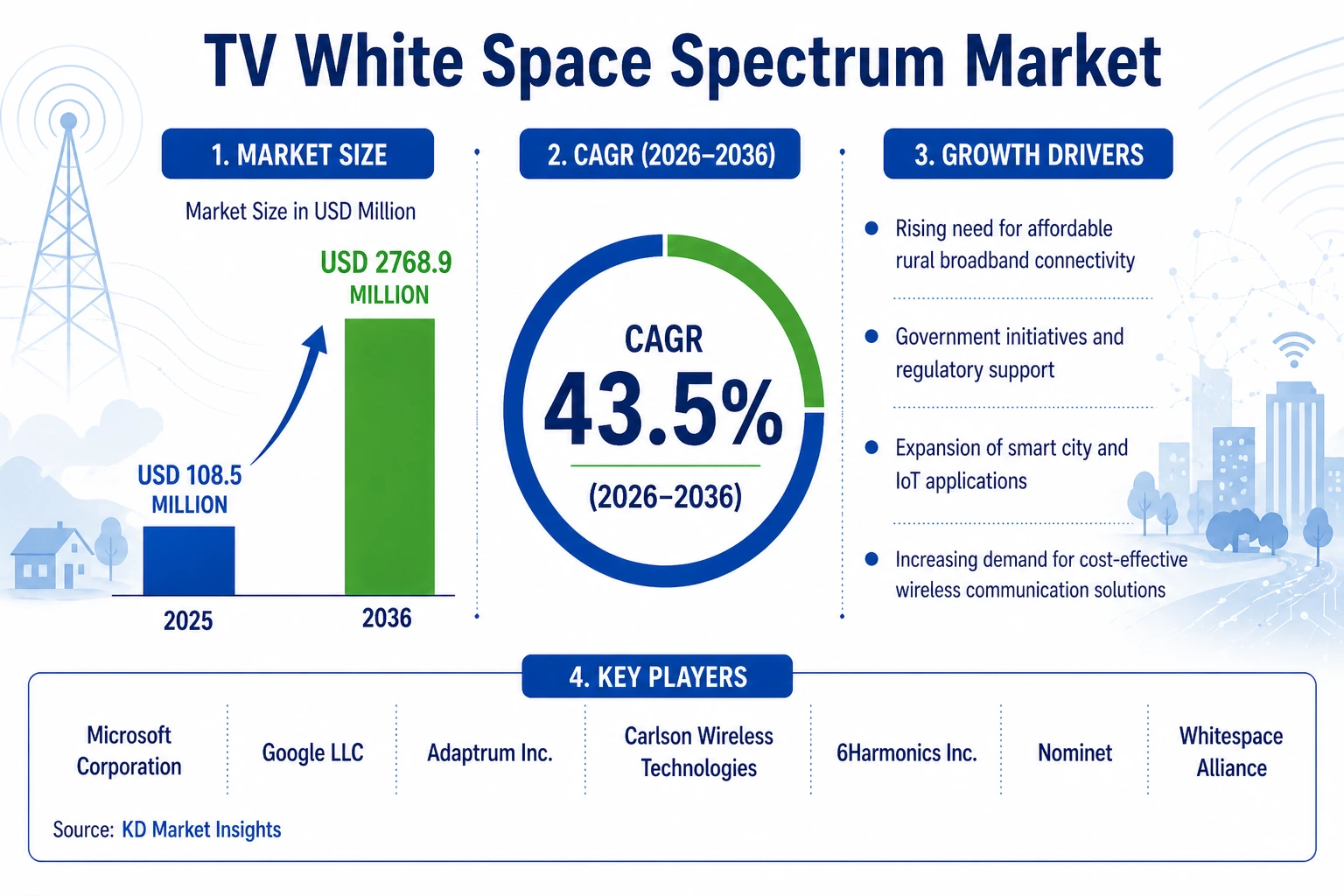
- 2025 Market Size: USD 108.5 Million
- 2036 Forecast Market Size: USD 2768.9 Million
- CAGR (2026–2036): 43.5%
- Largest Market: North America
- Fastest Growing Region: Asia-Pacific
- Key Market Drivers: Rising need for cost-effective rural and remote broadband connectivity.
- Key Players: Microsoft Corporation, Google LLC, Adaptrum Inc., Carlson Wireless Technologies, 6Harmonics Inc., Nominet, and Whitespace Alliance.
TV White Space Spectrum Market Size Report – In a Glance
As per the survey report on TV white space spectrum market, the market is expected to foresee a CAGR value of 43.5% during 2026-2036, and further generate a market size of USD 2768.9 million by the end of 2036. In 2025, the market size was value at USD 108.5 million revenue.
- The TV white space spectrum market’s growth is driven by rising need for affordable broadband connection.
- In Japan, the TV white space spectrum market growth is attributed by strong presence of advanced technological infrastructure.
- KDMI analyst’s growth analysis foresees limited technical expertise as the restraint for TV white space spectrum market.
- North America, having the highest market share in the TV white space spectrum market, is estimated to dominate the global market.
TV White Space Spectrum Market Analysis
TV or television white space spectrum is the unused radio frequencies in the TV broadcast bands, which can be repurposed for other wireless services, like broadband internet. These frequencies are often found between active TV channels and includes characteristics such as wide coverage range and the ability to overcome obstacles. These characteristics make them suitable for extending wireless connectivity in rural areas, bridge digital gaps, and enable machine-to-machine communications. According to the Federal Communications Commission (FCC) study report, only 61.9% of rural households have broadband connection including cable, fiber optic, and DSL, than 77.6% of non-rural households. And the fact is over 2.7 million households in rural areas have no internet subscription. This gap in broadband connections impact growth of TV white space spectrum market. The market expansion can be driven by implementing stringent regulations and developing broadband infrastructure in rural areas supporting adoption of high-end technologies.
Analyst’s Observation on Japan TV White Space Spectrum Market Survey
The Japan’s TV White Space Spectrum market growth is driven by strong presence of advanced technological infrastructure and stricter regulatory standards. The Japanese government is supporting white space solutions to improve rural connectivity and integrate smart city projects at remote locations. Adoption of innovation in cognitive radio and spectrum sharing technologies are driving commercial deployments of effective solutions. Japan’s telecom industrial expansion and adoption of automation provide an efficient solution for deployment of white space solutions. The internet society report shows, in Japan, there are more than 40.84 broadband connections per 100 habitants and 96% of the population has access to at least one device with 5G mobile internet. Japan has received a security preparedness score of 97.57 for 2024 Global Cybersecurity Index. This shows growing demand for solutions to enhance delivery of services across the country. Redline, Aviacomm, Meld Technology Inc, and Metric Systems Corporation are some of the leading market participants in the Japan.
|
TV White Space Spectrum Market: Report Scope |
|
|
Base Year |
2025 |
|
Estimated Market Size |
USD 108.5 Million in 2025 |
|
Forecast Year |
2026-2036 |
|
Projected Market Size |
USD 2768.9 Million in 2036 |
|
CAGR Value |
43.5% |
|
TV white space spectrum Market Key Trends/ Growth Drivers |
|
|
Restraint Factors
|
|
|
TV white space spectrum Market Segmentation |
|
|
TV white space spectrum Market Key Players |
|
TV White Space Spectrum Market Growth Drivers and Restraints
Growth Drivers
- Rising need for affordable rural broadband connectivity – The potential growth driver for global TV white space spectrum market is the rising need for affordable and reliable broadband connectivity in rural and underdeveloped regions. Traditional broadband infrastructure such as tower-based networks are expensive to deploy in remote areas due to limited infrastructure, low population density, and limited economic returns for telecom operators. TV white space spectrum technology helps to overcome such difficulties by offering low-frequency TV spectrum, which is designed to travel long distances, penetrate buildings, and vegetation, and does not demand for large number of base stations. TVWS is more preferred technology due to its cost-efficiency, large area coverage, and aligning with government regulations properties. Moreover, the deployment of TVWS technology is further driven by government launching “digital inclusion” initiatives, which lead expansion of TVWS technology as significant tool for rural broadband solutions.
- Government initiatives and regulatory support – Government-led initiatives and regulatory support is another significant driver for TVWS market. Global agencies like the FCC (US), Ofcom (UK), TRAI (India), and others are increasingly recognizing potential of unused TV frequencies to improve spectrum efficiency and connectivity, which led them to introduce environment-friendly policies to allow dynamic spectrum sharing. Many countries are focusing on the launch of pilot projects, smart village programs, and rural broadband missions to promote deployment of TVWS technology for widespread internet connections across sectors such as education, healthcare, and agriculture. Furthermore, government offering financial benefits on the adoption of TV white space spectrum technology builds confidence among industry participants and results in overall growth of market.
Restraints
- Limited awareness and technical expertise – One of major hurdles for global TVWS market growth is limited awareness of availability of high-precision broadband connections among potential users such as rural ISPs, agriculture operators, and small enterprises. Also, the deployment and operating processes require technical knowledge to efficiently setup and maintenance of system, which lacks in many developing regions. These factors result in limited adoption of TVWS technology in areas with low-income and price-constraint industries.
TV White Space Spectrum Market Segmentation
Our experts at KD Market Insights have segmented the global TV white space spectrum market research report as:
|
By Frequency |
|
|
By Application |
|
|
By Technology |
|
|
By Model |
|
|
By Vertical |
|
|
By Region |
|
TV White Space Spectrum Market Regional Synopsis
North America is the largest contributor in the global TV white space spectrum market, which is significantly driven by strong regulatory support from the FCC, numerous pilot projects, and active participation from technology companies focused on rural broadband expansion. The United States and Canada are increasingly deploying TVWS technology for smart agriculture, community internet programs, and IoT connectivity, making this technology more preferable. These countries are the most mature adopters of TVWS technology to meet their growing demand for high-precision, reliable, and sustainable broadband connections. As the internet users are growing rapidly, with accounting for 13 million internet users in the US in 2023 – demand for cost-efficient and large coverage is driving market growth.
Europe shows steady growth in the TV white space spectrum market due to greater support from Ofcom and EU-led spectrum innovation initiatives. Countries like the UK, Germany, and Finland are increasingly adopting and deploying TVWS technology in rural areas for increasing penetration of internet, smart farming, and public safety networks. Stricter spectrum policies limits TVWS adoption in underdeveloped areas, but rising digital transformation and government-backed initiatives is driving demand.
Asia-Pacific experienced potential growth in the TV white space spectrum market due to high-potential for cost-efficient broadband connections in rural areas with large populations. India, Japan, Singapore, and the Philippines are the largest contributors of the TVWS market, which is widely adopted for remote education, telemedicine, and agricultural monitoring. Also, rapid urbanization and IoT expansion in industries is further expanding growth opportunities for TV white space spectrum technology.
In Latin America, the TV white space spectrum market growth is propelled by the government adopting affordable broadband connections, particularly in rural regions. Brazil, Colombia, and Mexico are increasingly investing in technology to enhance public-private partnerships to deploy TVWS-based broadband in remote villages, schools, and farming sectors.
The MEA region sees growing interest in TVWS due to strong need for low-cost broadband solutions in African nations such as Kenya, South Africa, and Ghana, where the launch of TVWS broadband is rising at a steady level.
As per our analysts at KD Market Insights, the following five participants lead the North America TV white space spectrum market share:
- Microsoft Corporation
- Google LLC
- Crown Castle International Corp
- Comcast Corporation
- AT&T Inc
TV White Space Spectrum Market Competitive Landscape
Some of the significant participants who top the global TV white space spectrum market growth:
- Carlson Wireless Technologies, Inc
- Redline
- KTS Wireless
- Adaptrum
- 6Harmonics
- Shared Spectrum Company
- Metric Systems Corporation
- Aviacomm
- Meld Technology Inc

Need Customized Report for Your Business ?
Utilize the Power of Customized Research Aligned with Your Business Goals
Request for Customized Report- Quick Contact -
- ISO Certified Logo -



Frequently Asked Questions(FAQ)
TV White Space Spectrum Market
-: Our Clients :-